
You finally get your mold inspection report, open the PDF, and instead of the simple answers you hoped for, you see pages of photos, tables, and mold names that do not quite make sense. You might only know that something in your home does not feel right, and now you are staring at a document that seems written for a lab instead of a homeowner. It is easy to worry that one confusing sentence could mean a serious problem you are missing or an expensive repair you do not fully understand.
If you live in the Santa Clarita or Greater Los Angeles area, you are also dealing with homes that see real temperature swings, occasional heavy rains, and older construction details that make moisture tricky. That context matters, and a good mold inspection report should reflect it, whether you are in a hillside house in Santa Clarita or a condo closer to downtown Los Angeles. The report should translate what is happening in your walls, ceilings, and air into clear language so you can decide what needs to be fixed, how quickly, and by whom.
At Mailman Environmental, we have completed more than 3,000 inspections across Santa Clarita and the Greater Los Angeles area, and our team is certified by the California Department of Public Health and the Department of Occupational Safety and Health. We write mold inspection reports so homeowners, contractors, and sometimes real estate professionals can all understand the same story. In this guide, we will walk through the key mold inspection report details you should expect to see and how to use them to protect your home and health.
What A Professional Mold Inspection Report Should Do For You
A professional mold inspection report should work like a roadmap, not just a receipt for testing. At a minimum, it should answer three questions for you. Where is mold or moisture affecting my home, why is it happening here, and what are the next reasonable steps to address it. If your report does not touch all three, you are left guessing when it is time to make decisions about repairs and remediation.
Many people assume a mold report is only about lab results or a pass or fail label. In reality, numbers and mold names do not help much on their own. For example, an air sample could show a certain spore count, but unless you know how that compares to outdoor levels, the room’s history of leaks, and the current moisture readings, you cannot tell if this is a lingering issue or an active one. A strong report pulls those pieces together into a clear narrative instead of dropping them in separate sections without explanation.
When we prepare a report, we think about how you and your contractor will use it in day to day decisions. We connect visual observations, such as staining around a Santa Clarita bathroom window, with moisture readings in that wall cavity and any related lab data. Then we write conclusions and recommendations that explain the priority and scope of the problem. That structure turns a technical document into a practical tool, so you are not left trying to guess what a certain mold level means for your family or your budget.
Moisture Readings and Source Tracking Inside Your Report
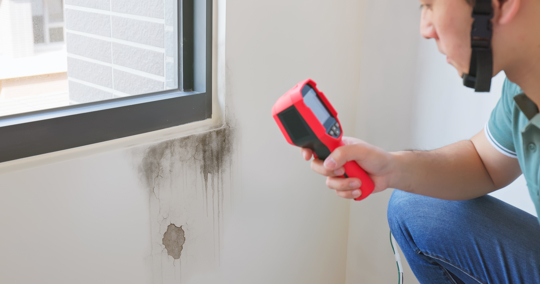
Mold cannot grow without moisture, so one of the most important parts of any mold inspection report is the moisture data. During an inspection, we use moisture meters and sometimes thermal imaging cameras to check walls, ceilings, and floors. The report should show where we took these readings and whether they were within a normal dry range or elevated compared to surrounding areas or known dry materials.
For example, in a Santa Clarita bathroom with a long history of shower use and no fan, we might record normal moisture content in most of the drywall, but elevated readings in the lower corner near the shower curb. The report would note those readings, often as percentages or relative values, and flag that area as a potential leak or chronic splash zone. That is very different from a quick visual look that might miss hidden dampness behind tile or paint that appears fine on the surface.
We also use moisture data to track likely sources. If we find elevated moisture directly under a second floor laundry in a Los Angeles townhome, and those readings drop off as we move away from that area, we document that pattern in the report. The narrative might state that moisture conditions are consistent with a plumbing leak at or near the laundry area. That kind of language gives your plumber and remediation contractor a starting point instead of forcing them to open large areas blindly and guess where the problem begins.
A strong report ties every significant mold finding back to a moisture condition wherever possible. When we see visible growth but all moisture readings test dry, we document that as well and consider other factors like past leaks that have been fixed or humidity issues that have improved. We also note when elevated humidity alone is a likely contributor, such as in a poorly ventilated bathroom or closet. Without this connection between mold and moisture, remediation often focuses only on cleaning or removal, and the underlying cause stays in place. That is how problems come back, and it is why we devote so much attention to moisture mapping in our assessments.
Air and Surface Samples: What Those Mold Numbers Really Mean
Air and surface samples are often the most confusing part of a mold inspection report, because they come with scientific names and numbers that look intimidating. In many reports, you will see air samples expressed as spore counts per cubic meter for different mold types, and surface samples described based on what was seen under a microscope from tape lifts or swabs. The value of those details depends on how they are interpreted, not just the raw numbers on the page.
Air samples tell you what types and quantities of mold spores are present in the air at a specific location and time. To make sense of those results, we typically compare them to an outdoor control sample or at least a sample from a non affected area. If a living room in a Los Angeles condo shows significantly higher counts of certain molds indoors than outdoors, that is a sign of an indoor source. If the indoor and outdoor levels are similar, especially for common outdoor molds, the report should say that the air looks typical for the area and does not suggest a distinct indoor source.
Surface samples are more targeted. We use them when we need to confirm whether a stain or growth on a specific surface is actually mold or some other material, such as soot or dirt. The lab might report that the sample contains certain mold structures, which we then relate to the surrounding conditions. For instance, if tape from a window frame in Santa Clarita shows heavy mold growth and we also recorded condensation and limited ventilation in that room, the report will likely describe a localized issue tied to chronic moisture at that surface and suggest both cleaning and moisture control.
Our team follows guidelines connected with our California Department of Public Health and Department of Occupational Safety and Health certifications when we decide where to sample and how to interpret the results. We avoid oversampling in areas where visual and moisture evidence already make the picture clear, and we do not claim that lab results alone can predict health outcomes. In your report, sampling sections should clearly state what the results suggest about indoor mold conditions and any limitations, such as short sampling periods or recent cleaning that could influence air levels or surface conditions.
Lab results are powerful when they are used with on site observations and moisture data. When they stand alone, they raise more questions than they answer and can be easily misunderstood. That is why our reports always connect the numbers back to real world conditions and follow up with conclusions and recommendations in plain language, so you can understand whether the data reflects an active problem, a past event, or typical background levels for the Santa Clarita and Greater Los Angeles area.
Conclusions and Risk Levels: How Inspectors Communicate Severity
The conclusion section is where all the different pieces of your mold inspection report should come together. Here, we step back from the individual findings and give you an overall picture. We look at whether the mold issue is localized to one bathroom or closet, or whether it appears in multiple rooms on different levels. We also consider whether the identified moisture sources are active, such as a current leak, or signs of past problems that have dried but still left visible damage or lingering growth.
In this section, we often use clear, straightforward language to describe severity. For example, we might state that mold growth is “limited and surface level on accessible materials” in one room, but “moderate to extensive with suspected involvement of concealed wall cavities” in another. We also explain whether conditions appear to call for professional remediation, handyman level repairs, or monitoring and maintenance. The goal is to help you prioritize, not to scare you or minimize legitimate concerns about your indoor environment.
Health related language in a responsible mold inspection report should be thoughtful and measured. We can describe that certain types of mold and moisture conditions may contribute to poor indoor air quality or can be irritating to occupants, especially those with allergies or asthma. However, we do not diagnose medical conditions or promise that remediation will resolve specific health symptoms. In our reports, we encourage clients to share findings with their healthcare providers if they have concerns, and we stay focused on the environmental side of the equation where our training and certifications apply.
Our commitment to clear communication and to following established safety standards is especially important in this part of the report. After thousands of inspections, we know how easily technical conclusions can be misunderstood if they are written in vague or overly technical language. That is why we write conclusions in plain language and avoid overpromising. When you read our summaries, you should finish with a solid sense of how serious the situation is, what type of work is likely needed, and whether immediate action is recommended or if there is room for scheduling and budgeting over time.
Recommendations and Next Steps: Turning Your Report Into Action
The recommendations section is where your mold inspection report becomes an action plan. This is where we outline what steps are appropriate based on the findings, moisture sources, and severity described earlier. A well written set of recommendations turns a worrying situation into a manageable project, with a clear order of operations and realistic expectations about what comes first.
Typically, we start by focusing on source control. If there is an active plumbing leak in a Santa Clarita bathroom or a roof penetration above a Los Angeles hallway, the first recommendation will be to repair that source. Without that step, even the best remediation will be temporary and mold will likely return. We then describe the type of removal or cleaning needed, such as removing specific sections of drywall, cleaning framing with appropriate methods, or discarding porous materials like carpet that cannot be adequately cleaned and dried.
From there, we address containment and verification. For more significant projects, especially when work involves opening walls or ceilings, we usually recommend professional containment to prevent cross contamination to other areas, followed by post remediation verification or clearance testing to confirm that conditions have returned to normal ranges. We also include preventive suggestions tailored to your home, such as improving ventilation, adjusting how often certain areas are used, or monitoring relative humidity in known trouble spots during different seasons.
Our network of reliable local contractors becomes especially valuable at this stage. Because our reports are written with clear locations, moisture sources, and recommended scopes of work, we can connect you with professionals who understand how to follow that plan efficiently. This does not guarantee specific results, but it does make the remediation process smoother and reduces the chance of miscommunication between inspection findings and on site work. For many clients, this connection is what turns a stressful discovery into a step by step solution that feels manageable.
Get A Mold Inspection Report You Can Actually Use
A mold inspection report should do more than confirm what you already suspect. It should show you where problems are, explain why they developed, and give you a realistic plan for fixing them and preventing them from returning. When all the key mold inspection report details are in place, you can talk to contractors, insurance adjusters, and even healthcare providers with a shared understanding of your home’s conditions.
At Mailman Environmental, we bring extensive local experience, strong safety certifications, and a commitment to clear communication to every inspection. We design our reports so that you can read them without a technical background and still know what needs attention and when. If you have a confusing report in hand or you are ready for a thorough mold inspection in the Santa Clarita or Greater Los Angeles area, we are ready to help translate your home’s conditions into an actionable plan.